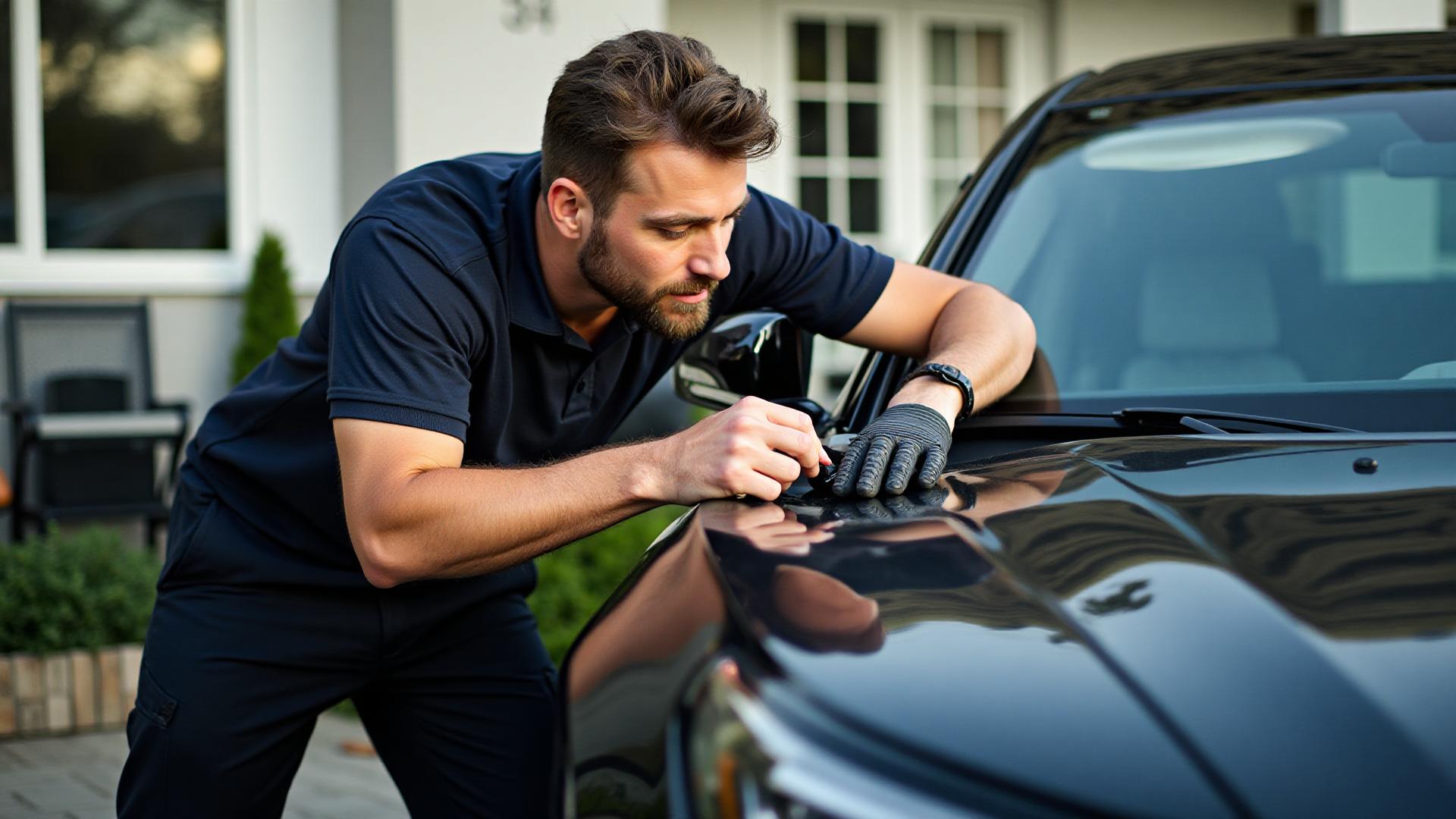
The $200/Hour
Mobile Paint Business Blueprint
How About 11 Repairs a Month Can Build a $100K/Year Business (Without a Shop, Paint Booth, or Employees)
If you love cars and like working with your hands…
You're closer than you think.
You don't need prior experience.
You don't need a commercial shop.
You don't need a massive investment.
You need the right skill.
The right setup.
And the right system.
What You'll Learn in This Blueprint
- The simple math behind $200/hour mobile repairs
- The 3 pillars that make this model work (Skill, Setup, System)
- A real repair walkthrough video
- Your realistic path from zero to consistent weekly income
By Matt
Founder — The Mobile Method™
Why This Window Is Open
Mobile auto body repair isn't a trend. It's a shift — and the biggest players in the collision industry have already started making moves that prove it.
The Signal Most People Miss
One of the largest body shop groups in the United States — a company with nearly 2,000 locations — recently acquired a mobile auto body repair company.
Let that sink in.
A collision giant didn't build their own mobile division.
They bought one that was already working.
Because they know what's coming.
When the biggest players in an industry start buying mobile operators, it's not a coincidence.
It's a signal.
Why This Is Happening
Four forces are colliding:
Vehicles are older than ever
The average car on US roads is now over 12 years old — a record high. Older cars mean more small cosmetic damage that owners fix out of pocket, not through insurance.
Body shops are backlogged & insurance-focused
Collision shops are drowning in ADAS-complex claim work. They don't want your $600 bumper scuff. It's not worth their time — but it's the perfect job for a mobile operator.
Customers want convenience
Nobody wants to leave their car at a shop for four days over a door ding. Mobile repair meets them where they are — at home, at work, during lunch.
The market is massive and fragmented
The US auto body industry is over $60 billion. Mobile represents a tiny fraction of that. People who build a mobile business now are entering a large market with room for serious operators.
"But How Do I Compete With the Big Guys?"
You don't. You don't have to.
Here's what most people miss when they hear "1,800-location collision giant buys mobile company":
Those acquisitions aren't about your neighborhood.
They're about fleet accounts — corporate contracts, rental car companies, dealership networks. That's where the big groups can use their scale.
They're not coming for Mrs. Johnson's bumper scuff on a Tuesday afternoon.
They can't.
A 1,800-location corporation can't send a tech to one driveway for a $600 repair and make the numbers work. The overhead eats it alive. The scheduling is a nightmare. The unit economics are broken.
That's your entire opportunity.
Solo mobile operators win on things big companies can't copy:
- Personal relationships. You show up. They remember your name. They tell their neighbor.
- Flexibility. You can be at a customer's house tomorrow. A corporate chain can't.
- Fair prices. No corporate overhead means you can charge a fair price and still run a strong business.
- Same-day answers. You quote in 10 minutes. They route through a call center.
The big players moving into mobile isn't a threat. It's a stamp of approval on the model — and a signal that the retail market they can't efficiently serve is wide open for independent operators.
The Real Question
The opportunity is real.
The demand is real.
The money is real.
And the people who'll capture it are the ones who start building their local reputation now — while most people are still figuring out what "mobile auto body" even means.
The question isn't whether you can compete.
It's whether you'll start.
Now let's look at what that opportunity actually looks like in dollars.
A $600 Repair in 3 Hours Works Out to About $200/Hour.
Let's use simple, conservative numbers.
Average small cosmetic repair: $600
Average time per repair: 2–3 hours
Be conservative:
$600 job
÷ 3 hours
= $200 per hour
Run Your Own Numbers
Now zoom out. Move the sliders and see what your year looks like.
$144,000
As a solo operator.
No shop. No booth. No employees.
Just skill + a simple system.
Now that you've seen the math, let's look at why this opportunity exists…
What It Actually Costs to Start
Most people ask this before anything else. Here's the honest answer.
Tools, chemicals, and dry goods: about $2,500
That's the from-scratch number, if you don't own any of the tools yet.
Most guys already own some of this. A lot of the people I talk to already have a compressor sitting in the garage. Some have prep equipment, sanders, a decent set of hand tools. If that's you, your number comes down — sometimes by a lot, since air is one of the bigger line items.
Worth checking what you have before you count on it. Not every compressor moves enough air for spray work.
The $2,500 covers everything you spray with, everything you prep with, and the supplies you'll burn through on your first jobs.
Your vehicle: what you already drive, if it works
You need one of three things. A pickup with a shell. A small van. A small cargo trailer.
If you own one of those already, your vehicle cost is zero. Start there. Plenty of people upgrade later, once the work is paying for it.
If you don't own one, that's a real cost and it swings too much for a number to mean anything. A used cargo trailer is often the most affordable option.
Buildout: $500 to $2,000
This is setting up the inside so you can actually work out of it. On the low end, plywood, screws, and some basic accessories. That's a weekend. On the high end, custom aluminum shelving.
Start low. The $500 version works fine. The $2,000 version just looks better.
The real total
If you already have a vehicle that works, and you're buying everything else new: roughly $3,000 to $4,500 to be up and running.
If you've already got a compressor or some prep equipment, less than that.
If you don't have a vehicle, add it.
A few smaller things sit outside that number. Business formation, insurance, fuel. None of them change the picture much, but they're real and you should plan for them.
At $600 a job, you're looking at five to eight repairs to cover what you put in. How fast that happens depends on how quickly you build the skill and find customers. That part isn't a number anyone can hand you honestly.
I'd rather you know all of this now than find out halfway through a call with me.
Why Small Cosmetic Repairs Are a Real Opportunity
Look around any parking lot.
You'll see:
- Bumper scuffs
- Key scratches
- Small panel damage
- Blend repairs
Customers usually have two choices:
- Leave their vehicle at a body shop for days
- Pay a specialist to fix it at home
Most body shops:
- – Focus on insurance work
- – Have higher overhead
- – Have longer turnaround times
Mobile repair works because:
- Lower overhead
- Faster turnaround
- Direct-to-customer pricing
- Customers value convenience
This isn't about replacing collision shops.
It's about specializing in high-margin cosmetic repairs customers want handled quickly.
So what does it actually take to make this work? It comes down to 3 things…
The 3 Pillars That Make This Model Work
1️⃣ The Skill
You must learn how to properly:
- Prep
- Blend
- Match color
- Control overspray
- Deliver consistent results
This is built through repetition and structure.
2️⃣ The Setup
A streamlined mobile spray system.
Not a commercial lease.
Not a $75,000 paint booth.
Just the right tools configured correctly.
Lean. Efficient. Profitable.
3️⃣ The System
This is where most techs struggle.
- Pricing correctly
- Choosing the right jobs
- Positioning yourself as a specialist
- Generating consistent leads
- Scheduling efficiently
Skill makes you capable.
Systems make you predictable.
The Realistic Path
This is not a "get rich quick" play.
It's a progression.
Stage 1
Build the Skill
Practice the workflow.
Develop blend control.
Understand material usage.
Gain confidence through repetition.
This stage matters.
Stage 2
Controlled Paid Jobs
Start small.
Lower-risk cosmetic repairs.
Document before & afters.
Refine efficiency.
Momentum builds here.
Stage 3
Consistent Weekly Jobs
Once skill and systems align:
2–4 jobs per week becomes realistic.
That's when income becomes predictable.
This is about building something real — not chasing hype.
Now let's look at what one repair is worth to your business…
What the Numbers Actually Look Like
Let's use real, conservative numbers.
Average cosmetic repair: $600
Typical material usage for a small-area blend repair:
- Toners
- Clear coat
- Reducer
- Sandpaper
- Masking materials
Average consumable cost per job: ~$30
That means:
(Remember — this is a lean mobile setup with very low overhead.)
Now break it down weekly.
2 Jobs Per Week
$570 × 2 = $1,140 per week
$54,720 per year
3 Jobs Per Week
$570 × 3 = $1,710 per week
$82,080 per year
4 Jobs Per Week
$570 × 4 = $2,280 per week
$109,440 per year
5 Jobs Per Week
$570 × 5 = $2,850 per week
$136,800 per year
That's not a big crew or a packed calendar.
That's 3–5 small cosmetic repairs per week.
Low overhead is what makes this model work. These are business examples before fuel, insurance, and taxes, not take-home pay or a guarantee.
Want help turning this into a real income stream?
I work with a small number of people each month to help them start and land their first paying jobs fast.
Because this is hands-on and personalized, I only open a limited number of spots at a time.
Book a Free Strategy Call→On the call, we'll talk through where you are, what you want to build, and whether MABA is a fit. It usually runs 45 minutes to an hour.
Watch a Real Cosmetic Repair Step-by-Step
I recorded a full repair showing:
- Setup
- Prep
- Spray technique
- Blend
- Clear application
- Final result
Seeing the process makes the opportunity real.
"What If…"
Here's the honest answer to each of those questions.
What if I'm not experienced?
Most people who join MABA aren't. Joseph came from a body shop — but even he didn't have a system. Rafael came from a corporate desk. David ran an online business. What matters more than experience is the willingness to practice the process. The skill is teachable. The system is already built. Your job is to follow it.
What if I can't find customers?
This is the most common fear — and the one most people solve faster than they expected. MABA includes a done-for-you SEO-optimized website and CRM that starts working before you book your first job. You're not building from scratch. The infrastructure is already there.
What does it cost to start?
What if it doesn't work?
That's a fair question. Here's what we know: Joseph made $700 in week four. Rafael made $500 in week six. David made $600 in week four. None of them had guarantees. They had a system and a coach. That combination is what makes the difference between YouTube and MABA.
Still wondering if this is for real? Here's my story and your next step…
Want help turning this into a real income stream?
I work with a small number of people each month to help them start and land their first paying jobs fast.
Because this is hands-on and personalized, I only open a limited number of spots at a time.
Book a Free Strategy Call→On the call, we'll talk through where you are, what you want to build, and whether MABA is a fit. It usually runs 45 minutes to an hour.
Why I Teach This
Before I built a mobile auto body business, I was a corporate lawyer.
On paper, I had "made it."
Stable income.
Prestigious career.
Clear path.
But there was one problem.
My income was capped by someone else's system.
My time was controlled.
My schedule wasn't mine.
And I didn't want to spend the rest of my working life renting out my time in six-minute increments.
So I left.
I built a mobile auto body business from the ground up.
No shop.
No massive overhead.
No insurance dependency.
Just a focused system built around high-margin cosmetic repairs.
I started that business in 2011. It grew to about $1.8 million in annual revenue, and over 15 years my team generated more than $14 million in total revenue.
It wasn't luck.
It was a repeatable model built on skill, structure, and disciplined execution.
Over the years, I trained more than 30 technicians and refined the system into something repeatable.
What you're reading in this blueprint isn't theory.
It's the simplified version of a model that has worked in the real world — at scale.
I don't teach shortcuts.
I teach structure.
Because freedom doesn't come from luck.
It comes from systems.
Real People. Real First Jobs.
These aren't curated success stories from two years in. This is what happened in the first 4–6 weeks.
Joseph
Body Shop Tech → Independent Operator
Joseph had the skill. He showed up every day, did the work, and handed his time to someone else. Four weeks after joining MABA, he completed his first repair for $700. No boss. No shop. No split.
"The ceiling I'd been bumping against my whole career wasn't real. It was just the building I was working in."
Rafael
Corporate Desk Job → First Repair in 6 Weeks
Rafael sat behind a desk all day doing work he didn't care about. He loved cars. His job had nothing to do with them. Six weeks after joining, he completed his first repair and made $500. He didn't have to quit his job first. He could start building another option alongside the life he already had.
David
Online Business Owner → Hands-On Income
David already had a business, but he wanted something more tangible — something connected to cars. Four weeks in, he completed his first repair and made $600.
"This wasn't just extra money. This was a real-world skill I can use to generate income whenever I need it."
Joseph, Rafael, and David all started where you are right now. Results vary. These are individual results, not a guarantee.
A note on availability:
I personally lead every coaching call inside MABA. That limits how many new students I can take on each month without the quality of coaching dropping.
If you're serious about starting this in the next 60–90 days, it's worth having a conversation now rather than later.
Spots aren't always open. When they're full, they're full.
Want help turning this into a real income stream?
I work with a small number of people each month to help them start and land their first paying jobs fast.
Because this is hands-on and personalized, I only open a limited number of spots at a time.
Book a Free Strategy CallOn the call, we'll talk through where you are, what you want to build, and whether MABA is a fit. It usually runs 45 minutes to an hour.